The Hidden Costs of Construction Admin: How Much Time GCs Lose to Manual Submittals & RFIs

.png)
TL;DR: What This Post Covers
The admin tax you can't see on your expense is the 330+ hours of PM and PE time that a typical $50M per year general contractor loses every year to manual RFI and submittal processing, without a single line item calling it out.
Quick numbers for a $50M GC:
- ✅ 330 hours/year lost to manual processing (8+ weeks of PM/PE time)
- ✅ $26K–$40K in direct admin costs
- ✅ $30K–$100K+ in hidden costs (field delays, rework, schedule slippage)
- ✅ 200 hours/year recoverable by switching to digital workflows

The Admin Tax You Can't See on Your Expenses (But It's Definitely There)
Look, nobody wakes up thinking about how much time their team spends logging submittals. You're worried about the schedule. The budget. Whether that steel shipment is actually arriving on Thursday like they promised.
But here's what happens. Your project managers and engineers are bleeding hours into administrative work that nobody's tracking. They're updating Excel logs. Chasing email threads. Copying files into three different folders because that's just how your company does it. And because this work gets lumped into "project management," it disappears. No separate cost code. No visibility.
The shift that makes this matter now is that RFIs and construction submittals aren't just paperwork anymore. They've become schedule drivers. When your projects had 50 RFIs, sure, you could muscle through with email and spreadsheets. But 200 RFIs per project? 800 submittals? That's a different animal. The complexity has increased, and your processes probably haven't.
What we're covering:
- How to quantify the admin drag on your team
- The hidden costs that hurt way more than the time itself
- What changes when you move from manual to digital workflows
- How SubmittalLink turns construction admin from a cost center into margin protection
How a $50M GC Loses 333 Hours Per Year to Manual RFIs and Submittals
A $50M general contractor loses 333 hours per year to manual RFI and submittal processing, which equals more than eight full weeks of project management work absorbed into "just doing the job."
Let's talk about Ridgeway Builders. They're not real, but they're realistic:
Company profile:
- $50M in annual revenue
- 5 projects/year (commercial + light industrial)
- ~5 project managers + 7 project engineers
Annual workload:
- 5 projects × (100 RFIs + 300 submittals each)
- = 2,000 items/year to create, track, review, and close out
Time calculation:
- 10 minutes per item (just the admin work, not technical review)
- Opening emails, saving files, updating logs, checking status, following up
- 2,000 items × 10 minutes = 20,000 minutes
- = 333 hours = 8.3 weeks of full-time work
Financial impact:
- Blended PM/PE cost: $80–$120/hour
- Direct admin cost: $26,000–$40,000/year
- And that's before the downstream costs hit you
Want to see the full breakdown? Check out managing submittals in Excel versus dedicated software for the complete picture.
The Hidden Cost Stack of Delayed RFIs: Where the Real Money Leaks Out
The hidden cost stack of delayed RFIs includes field labor standby, rework from unclear direction, and schedule slippage that extends your general conditions exposure, often adding $30,000 to $100,000+ in avoidable costs annually beyond the direct admin time.
The direct admin time is what you can see (if you're looking). The real damage sits in what happens downstream when RFIs move slowly through your system.
Field Labor Standby and Inefficiency
Field labor standby and inefficiency happen when crews are waiting for RFI answers and either stand idle or shift to lower-productivity tasks while burning your labor budget.
Picture this. You've got a five-person crew on site. They hit a conflict or an unclear detail. The foreman calls it in, but the RFI takes three days to work through your system and get to the architect. Meanwhile, those guys need something to do, so they move to prep work or help another trade. Their efficiency drops. Maybe they're standing around for a few hours because there's genuinely nothing productive left to do.
Cost per incident:
- 5-person crew × $60/hour × 4 hours of standby/reduced productivity
- = $1,200 per incident
- Multiple incidents per project add up fast
Rework and Out-of-Sequence Work
Rework and out-of-sequence work result from crews making assumptions when they can't wait for RFI answers, leading to installed work that needs to be redone or revisited once the actual direction comes back.
This one hurts. Your team can't wait forever, so they make their best guess and keep moving. Then the RFI comes back with different direction. Now you're either fixing it or you're doing work out of sequence that creates coordination headaches later.
Typical impact:
- $5,000–$20,000 per rework event (depending on trade)
- And I'm being conservative here
Schedule Slippage and General Conditions Exposure
Schedule slippage and general conditions exposure occur when delayed RFIs affect your critical path activities, extending project duration and accumulating daily general conditions costs of $3,000 to $8,000 plus equipment rentals and potential liquidated damages exposure.
This is where small problems become big problems. An RFI delay on a critical path item pushes your schedule. Maybe just a few days. But your general conditions don't stop. Your site trailer, your super, your temporary power, your equipment rentals... they're all running at $3,000 to $8,000 per day.
Real-world math:
- 3 days of delay = $10,000–$24,000
- Close to substantial completion with LDs? Now you're talking real money
Add it all up. Even if you only have a few delayed RFIs per year that create these downstream effects, you're easily looking at $30,000 to $100,000+ in avoidable costs. And that's on top of the admin time we already talked about.
What Changes When You Automate RFIs and Submittals
What changes when you automate RFIs and submittals is the shift from disconnected tools and manual tracking to a centralized system that cuts admin time per item by 60% while reducing cycle times and schedule risk.
Manual Workflow Characteristics
Manual workflow characteristics include using multiple disconnected tools like email, Excel, shared drives, and owner portals while project managers and engineers waste time on clerical tasks such as logging, file naming, and status chasing, creating high latency with poor visibility and increasing the risk of version errors and missed deadlines.
You know what this looks like because you're probably living it:
The manual workflow reality:
- RFI comes in via email → log it in Excel (or forget and log it later)
- Save PDF to shared drive with your naming convention
- Forward to design team through their portal
- Set reminder to follow up
- Check back in 3 days
- Send another email asking for status
And the submittal process? Even worse. Multiple revisions. Version control nightmares. "Wait, is this the one the architect approved or the one we resubmitted?"
The risks:
- Missed deadlines because something fell through the cracks
- Disputes at project end because your logs don't match theirs
- Version errors that lead to the wrong detail getting built
Digital Workflow with SubmittalLink
Digital workflow with SubmittalLink creates a centralized source of truth for RFIs and submittals with automated status tracking, standardized workflows, and templates that reduce touch time per item while speeding up cycle times and minimizing delay-related costs.
What changes:
- ✓ Everything lives in one place
- ✓ Automatic notifications to the right people
- ✓ System tracks who has it, when it's due, what the status is
- ✓ No more "checking in" emails
- ✓ No more updating three different logs
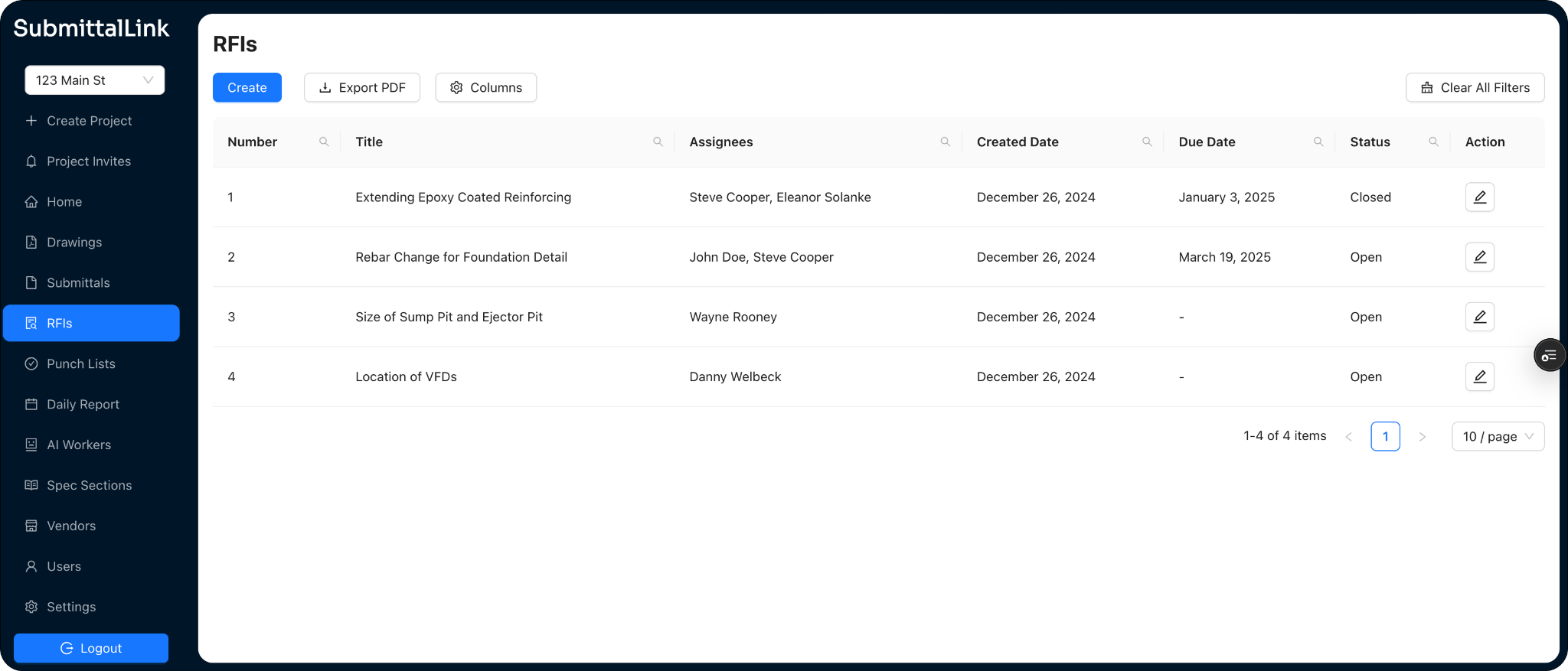
The workflows are standardized. Your team isn't reinventing the process on every item. Pre-built submittal templates keep things consistent. And because everyone's working in the same system, you've got real visibility with ball-in-court tracking. You can see instantly which RFIs are aging, which submittals are overdue, where your bottlenecks are.
Quantification Example
The quantification example shows that reducing manual processing time from 10 minutes to 4 minutes per item saves 200 hours per year for a contractor handling 2,000 items annually, recovering $20,000 in PM and PE capacity before counting operational improvements.
Let's use Ridgeway Builders again:
- Currently: 2,000 items/year × 10 minutes each
- With digital platform: 2,000 items/year × 4 minutes each
- Savings: 6 minutes per item
Annual impact:
- 2,000 items × 6 minutes saved = 12,000 minutes = 200 hours/year recovered
- At $100/hour blended cost = $20,000/year in freed PM/PE capacity
- Before counting operational gains
And remember, that's before you count the operational gains. Faster cycle times mean fewer field delays. Better visibility means fewer things falling through the cracks. Standardized processes mean less rework from miscommunication.
Real contractor results:
- Submittal turnaround dropped from 10+ days to 4 days
- Daily time savings of 2+ hours on commercial projects
The time savings are nice. The operational improvements are where you really win.
From Admin Drag to Competitive Advantage: Your Roadmap with SubmittalLink
From admin drag to competitive advantage means treating RFIs and submittals as leverage points for schedule reliability and margin protection rather than unavoidable paperwork, starting with a pilot project that proves the value through measurable improvements in cycle times and reduced hidden costs.
Here's how to think about this differently. RFIs and submittals aren't paperwork. They're decision points. They're schedule dependencies. They're risk management tools. When they move quickly and cleanly through your system, your projects run better. When they don't, you bleed money in ways that don't show up until it's too late.
Your Action Plan
Executive-level action steps include benchmarking your current admin load, quantifying hidden costs like standby and rework, running a pilot project through SubmittalLink, and tracking pre- and post-pilot KPIs such as cycle times, admin hours, and delay-related costs.
Step 1: Benchmark where you are now
- How many RFIs and submittals does your typical project generate?
- How much time does your team actually spend on the admin work?
- (Ask them. You might be surprised.)
Step 2: Quantify the hidden costs
- How often are you dealing with field delays tied to slow RFIs?
- When was the last rework event from unclear direction or delayed submittals?
- What did that cost?
Step 3: Pick one pilot project
- Don't try to change everything at once
- Run one project through SubmittalLink
- Track what happens
Step 4: Measure the KPIs that matter
- RFI cycle time (how long from question to answer)
- Submittal cycle time
- PM/PE hours spent on admin (versus before)
- Delays or rework tied to RFI and submittal process
If you're still managing RFIs and submittals through spreadsheets and inboxes, you're probably giving up weeks of PM time and tens of thousands in hidden costs every year. Maybe more.
Ready to Recover Those Lost Hours?
→ Book a demo with SubmittalLink and we'll show you exactly how much time and money your team could recover with a dedicated construction submittal software platform. Most GCs see measurable improvements in their first 30 days.
Because at the end of the day, this isn't about buying software. It's about giving your team their time back so they can focus on actually building projects instead of chasing paperwork. And that's a competitive advantage.
Frequently Asked Questions
How much time does a typical GC spend on manual submittal and RFI processing?
A typical $50M general contractor spends approximately 333 hours per year (over 8 weeks of full-time work) on manual RFI and submittal processing across 2,000 items annually, with each item requiring about 10 minutes of administrative handling beyond the actual technical review.
What are the hidden costs of delayed RFIs beyond admin time?
The hidden costs of delayed RFIs include field labor standby ($1,200+ per incident for a 5-person crew), rework from unclear direction ($5,000 to $20,000 per event), and schedule slippage that extends general conditions exposure ($3,000 to $8,000 per day), often totaling $30,000 to $100,000+ annually in avoidable costs.
How much can digital submittal management reduce processing time?
Digital submittal management can reduce processing time from approximately 10 minutes per item to 4 minutes per item, recovering 200 hours per year for a contractor handling 2,000 items annually, which translates to $20,000 in freed PM and PE capacity before counting operational improvements like faster cycle times and reduced field delays.
What should I measure in a pilot project to evaluate submittal software?
You should measure RFI cycle time (how long from question to answer), submittal cycle time, PM and PE admin hours spent on processing, instances of field delays or rework tied to the RFI and submittal process, and overall project closeout time to evaluate whether submittal software is delivering measurable improvements.
Is SubmittalLink easier to use than Procore or other all-in-one platforms?
SubmittalLink is purpose-built specifically for submittal and RFI management, making it simpler and faster to implement than all-in-one platforms like Procore that may include features most mid-sized GCs don't need. Compare SubmittalLink to other platforms to see which approach fits your team's workflow and budget.
Can I try SubmittalLink on just one project first?
Yes, you can start with a single pilot project to test SubmittalLink's impact on your workflows and measure improvements in cycle times, admin hours, and field coordination before rolling it out company-wide. Contact our team to discuss a pilot project that fits your schedule.